
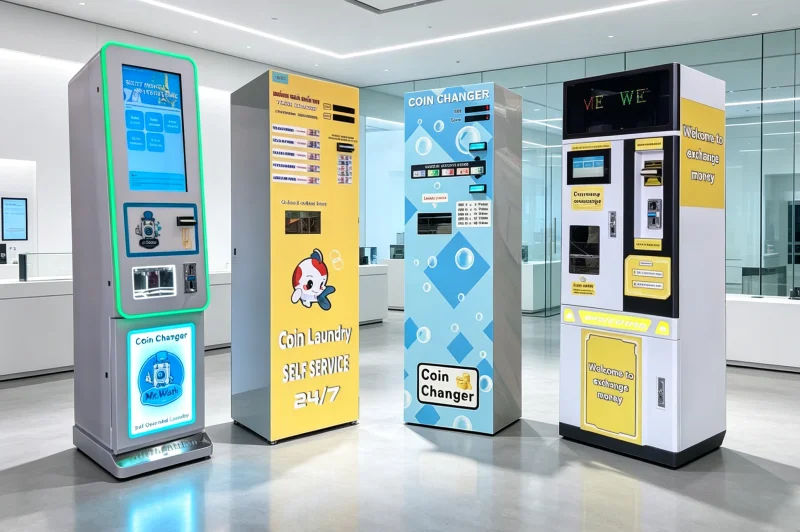
For operators of offline self-service venues, a token exchange machine is far more than a coin-changing device — it is the core payment hub connecting customer transactions to on-site consumption. A poorly chosen machine leads to frequent jams, counterfeit banknote losses, accounting discrepancies and customer complaints, eroding both revenue and brand reputation. A well-selected model enables 24/7 unattended operation, zero-error reconciliation and minimal downtime, directly reducing labor costs and boosting operational efficiency.
This guide walks you through a structured, data-backed selection framework to help you avoid low-price traps and feature bloat, and find the best fit for your venue’s traffic and operational needs.
1. Match Your Scenario First: Avoid Performance Mismatch
The first step to buying a token exchange machine is not comparing specs or prices, but mapping your real-world use case. Choosing the wrong configuration leads to either overpaying for unused features, or underperforming under peak traffic.
1.1 Select by Customer Traffic Volume
- Low-traffic venues (≤50 transactions per day): Community laundromats, small convenience stores, mini amusement spots. A basic stable model is sufficient; prioritize reliability over high-speed dispensing.
- Medium-traffic venues (50–200 transactions per day): Mid-sized arcades, family entertainment centers, chain self-service locations. Choose mid-to-high end configurations with steady dispensing speed and accurate recognition to reduce customer wait times.
- High-traffic venues (≥200 transactions per day): Large amusement parks, scenic spots, prime shopping mall locations. Require top-tier models with high-speed dispensing, extra-large banknote/coin hoppers and multi-site centralized management.
1.2 Select by Installation Environment
Indoor climate-controlled venues can balance function and cost. For outdoor, semi-outdoor, dusty or humid locations, prioritize dustproof, waterproof, wide-temperature and anti-theft features. For unattended remote locations, focus on network reliability and proactive fault alerts.
1.3 Select by Payment Requirements
Cash-only models are no longer suitable for most modern consumer habits. Most venues should choose all-in-one machines that accept both banknotes and mobile QR payments. If you run a membership system or accept group-buy vouchers, verify compatibility with those functions in advance.
2. Core Components: Determine Machine Reliability
The recognition module, dispensing mechanism and payment channel are the three core components of a token exchange machine. They account for most of the price difference between models, and directly determine failure rate and service life.
2.1 Banknote Recognition Module: Counterfeit Detection as the Bottom Line
Prioritize machines equipped with well-recognized brand-name recognition modules. For high-traffic scenarios, choose models with multi-layer counterfeit detection (infrared, magnetic, spectral scanning) that achieve a counterfeit rejection rate of 99.9% or higher, support both new and old RMB banknotes, and allow remote algorithm updates.
For low-traffic locations, cost-effective domestic certified modules are acceptable, but avoid unbranded OEM products — failed counterfeit detection causes direct financial loss.
2.2 Coin Dispensing Mechanism: Jam Rate as the Core Indicator
The two most important metrics for a dispensing mechanism are dispensing speed and jam rate. For medium and high-traffic venues, select high-speed models that dispense ≥100 tokens per minute with a jam rate below 0.01%.
Always confirm that the machine supports your existing token size and material to avoid retrofitting costs later. A anti-fishing design at the dispensing outlet — with infrared detection plus a physical baffle — is essential to prevent theft with wires or tape.
2.3 Payment Channel: Fund Security First
Choose machines with direct integration to official WeChat Pay and Alipay channels. Funds settle directly into your business account without going through a third-party pool, ensuring fast settlement, transparent fees and maximum fund security.
Be cautious of low-cost machines using second-tier payment processors. While they may advertise lower fees, they carry risks of fund withholding or platform closure.
3. Hardware Quality & Environmental Adaptability
Token exchange machines are high-frequency self-service devices. Build quality directly determines service life, especially for semi-open or outdoor installations.
3.1 Body Structure & Anti-theft Design
For unattended, semi-outdoor or outdoor locations, choose machines with thick cold-rolled steel bodies, anti-pry locks and reinforced structures, with tempered glass front panels. Indoor premium venues can consider aesthetic design, but should never compromise on basic anti-theft performance.
3.2 Environmental Tolerance
Outdoor installations require wide-temperature operation (typically -10°C to 50°C) and a dustproof/waterproof rating of IP40 or higher to prevent jams in cold weather, downtime in heat, and sensor damage from dust. For venues near pools or hot springs, confirm that circuit boards have moisture-proof and anti-corrosion coating.
3.3 Power & Network Compatibility
For locations with unstable voltage, choose models with wide-range power supplies (110V–220V) and power-off memory function, which automatically syncs data after power restoration and avoids accounting errors.
For network connectivity, prefer machines with wired + WiFi + 4G triple connectivity. Remote locations can use a data SIM card to ensure stable payment links and reduce “paid but no token” customer complaints.
4. Back-end Management System: The Real Way to Cut Labor Costs
Many buyers overlook the management system at purchase, only to discover later that manual reconciliation and on-site inspections are their biggest labor expense. A robust cloud-based management system dramatically reduces operational workload.
- Real-time reconciliation & reporting: Tracks every transaction and auto-generates daily/weekly/monthly operational reports, providing clear revenue and expense breakdowns.
- Multi-device centralized management: Monitor status and revenue of all machines across multiple locations from a single mobile dashboard, eliminating the need for on-site checks.
- Proactive fault alerts: Pushes notifications to administrators for jams, low coin levels, full banknote boxes or network anomalies, enabling fast resolution and lower complaint rates.
- Auditable data logs: Retains complete operation and transaction records for accurate discrepancy tracing.
5. After-sales & Maintenance Support
A token exchange machine is not a one-time purchase. Long-term service support directly impacts machine uptime. Small unbranded suppliers often disappear after sale, leaving you with costly downtime.
- Response speed: Prioritize brands with local service partners and nationwide warranty. In major cities, look for 24-hour response and 48-hour on-site repair.
- System upgrades: Free remote upgrades for banknote algorithms, payment interface updates and new features directly extend the machine’s service life. Confirm this before purchasing.
- Wearable parts supply: Dispensing discs, recognition sensors and drive belts are common wear parts. Verify ongoing parts availability and reasonable pricing to avoid being stuck with a broken machine.
6. Cost Calculation: Consider Total Cost of Ownership (TCO)
Never compare only sticker prices. Calculate the total cost of ownership over the machine’s lifecycle to avoid “saving a few hundred on purchase, losing thousands on operations.”
- Purchase cost: Basic models $150–$300, mid-range models $300–$600, high-end smart models $600+, varying by configuration.
- Operating cost: Payment processing fees, data plan costs, periodic wearable part replacement.
- Hidden cost: Revenue loss from downtime, manual reconciliation labor, theft losses and customer churn.
Within your budget, always prioritize quality core components over extra gimmick features that add cost and failure points.
Final Quick Selection Checklist
- Define your scenario: traffic level, environment, payment methods, number of locations.
- Lock in core specs: recognition module grade, dispensing speed & jam rate, payment channel type.
- Verify build quality: body material, environmental rating, power and network stability.
- Test back-end functions: reconciliation efficiency, multi-device management, alert system.
- Confirm after-sales: response time, free remote upgrades, wearable parts supply.
- Calculate total cost of ownership and select the best value option.
A token exchange machine may look like a small piece of equipment, but it acts as the mobile checkout of any self-service venue. Investing time to choose the right unit pays off long-term with lower maintenance effort, fewer hidden costs and stable revenue.